|
Issue No. 013 · Tue, May 19, 2026
|
● Daily Brief
|
|
|
Decision Layer
|
Finance
· 5 min read
|
|
| YS |
From Yatharth Sejpal · CEO, KNOWIDEA |
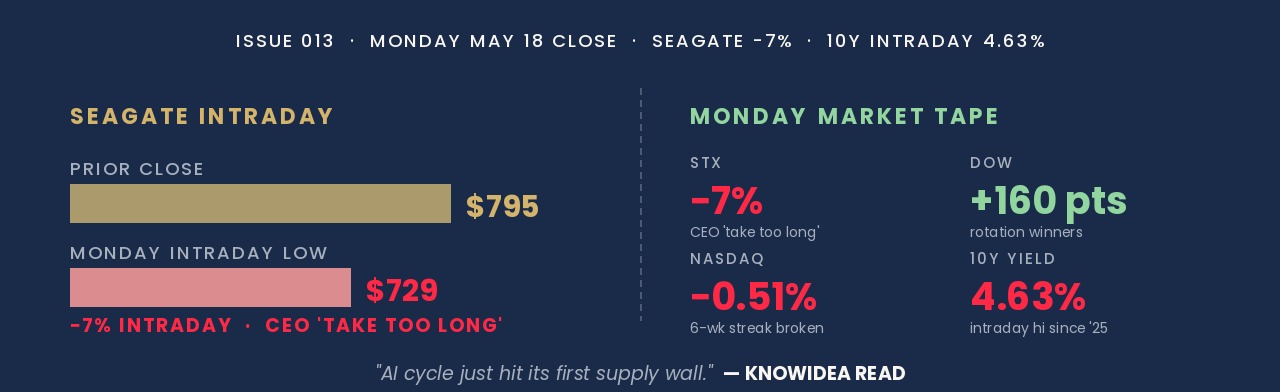
Monday delivered the first clean look at what comes after the AI mega-cap leadership trade exhausts itself. At a JPMorgan investor conference, Seagate Technology CEO Dave Mosley said building new memory-fab capacity “would just take too long” to meet AI-driven demand. The stock fell 7 percent off a session high of $800.44 to a low of $729.14 against a $795.47 prior close. The cascade was immediate and sector-wide: Micron Technology -3 to -6 percent intraday, Western Digital -4.8 percent, Sandisk -5.3 percent, Nvidia and Broadcom each -1 percent, the iShares Semiconductor ETF (SOXX) and VanEck Semiconductor ETF (SMH) -2 percent apiece. The Nasdaq Composite fell 0.51 percent to 26,090.73 — its second straight loss and the end of a six-week win streak. The S&P 500 slipped 0.07 percent to 7,403.05. But the Dow Jones Industrial Average rose 159.95 points (+0.32 percent) to 49,686.12 on a rotation into industrials, energy, and consumer staples: 3M +4.32 percent, Salesforce +3.38 percent, Chevron +2.57 percent led S&P winners. The US 10-year Treasury yield touched 4.63 percent intraday — its highest level since early 2025; the 30-year sat near 5.13 percent, a level last seen in 2007.
The session’s second leg arrived after the bell. Trump posted on Truth Social that he was postponing a Tuesday strike on Iran after the leaders of Qatar, Saudi Arabia, and the United Arab Emirates personally requested he “hold off” because “serious negotiations are now taking place.” Iran’s revised peace proposal — relayed via Pakistani mediators — reportedly includes a long-term nuclear freeze (not full dismantling), enrichment-material transfer to Russia rather than the US, and dropped demands for direct US financial compensation in exchange for international guarantees. Inside, we unpack why Mosley’s “take too long” remark just rewrote the AI-capex thesis from supply abundance to supply constraint, what the rotation into 3M/Salesforce/Chevron tells you about where institutional money is reseating itself, and why Nvidia’s Wednesday-after-the-bell print is now the most important earnings event of 2026 to date.
|
Seagate just broke the AI cycle: ‘new factories take too long.’
The AI-infrastructure trade has been priced for two years as a supply-abundance story — capex would be funded, capacity would be built, demand would be met. Monday a CEO standing on a JPMorgan stage said the second clause out loud is wrong. Building new memory-fab capacity, Dave Mosley said, “would just take too long.” The market read it as the first credible operator-level admission that AI demand is now binding against physical-world manufacturing limits. The cohort sold off uniformly. The Dow held up because the rotation went where institutional money has been queuing for weeks: 3M, Salesforce, Chevron, the industrials and energy names. The 10-year touched 4.63 percent intraday on the same tape.
Monday Close · Seagate -7% on AI Memory Capacity Warning · 10Y to 4.63% · Mon, May 18, 2026
The comment was buried inside a routine investor presentation. Asked about meeting AI-driven storage demand, Mosley said building new factories “would just take too long” and that adding capacity at scale would “slow the rate of growth on that technology”. The market read both clauses literally. Seagate shares fell from a session high of $800.44 to an intraday low of $729.14 — a -8.9 percent drawdown peak-to-trough — before closing roughly -7 percent against the $795.47 prior close. The cascade was immediate. Micron Technology fell 3 to 6 percent intraday on the same supply-constraint read, Western Digital dropped 4.8 percent, Sandisk 5.3 percent. Nvidia and Broadcom each lost about 1 percent ahead of NVDA’s Wednesday-after-the-bell print. The iShares Semiconductor ETF (SOXX) and VanEck Semiconductor ETF (SMH) closed roughly 2 percent lower. Crucially, Seagate is still up more than 167 percent year-to-date and 582 percent over two years — the selloff is not the start of a bear market in storage, but the first session where supply discipline became the structural narrative instead of demand abundance.
The Dow held up because the rotation went where institutional money has been queuing all week. 3M led S&P 500 gainers at +4.32 percent, Salesforce +3.38 percent, Chevron +2.57 percent; the Energy Select Sector SPDR (XLE) extended Friday’s outperformance; financials and consumer staples joined. UnitedHealth fell 4.8 percent (the second straight session of pressure after Berkshire’s Friday exit disclosure); Caterpillar -2.90 percent, Strategy (MSTR) -4.2 percent. Regeneron (REGN) cratered 10.5 percent after its Phase 3 metastatic-melanoma trial failed to reach statistical significance — the cleanest reminder that even the highest-conviction long-duration biotech names trade with binary risk inside the rate-hike regime. The 30-year US fixed mortgage rate climbed to 6.68 percent, an immediate flow-through of Friday’s 10-year spike into household borrowing. BTIG’s Jonathan Krinsky published a note dated Sunday flagging that since 2003, in five of the six prior instances when SPY lost more than 1 percent immediately following a daily RSI of 75-plus, the index went on to record at least a 7 percent peak-to-trough drawdown in the following weeks.
The session’s second leg was geopolitical and arrived after the bell. Trump posted on Truth Social that he was postponing a planned Tuesday strike on Iran following personal requests from the leaders of Qatar, Saudi Arabia, and the United Arab Emirates, who told him “serious negotiations are now taking place.” He instructed the Pentagon to remain prepared for “a full, large scale assault of Iran, on a moment’s notice.” Iran’s revised proposal — relayed via Pakistani mediators — reportedly offers a long-term nuclear freeze (not full dismantling), transfer of enriched uranium to Russia rather than the US, and dropped demands for direct US financial compensation in exchange for international guarantees. Index futures eased after-hours. Nvidia reports Wednesday after the close; Target reports Wednesday morning; Walmart reports Thursday morning. Bank of America’s Savita Subramanian wrote that “the engine of consumption growth from the 80s onward — skilled professional services, filled by college grads — is gumming up,” noting April’s tech layoffs and the college-grad unemployment rate at “recessionary levels.” The session was two stories: an AI cycle hitting its first physical-world constraint, and a war that just got two days closer to ending or escalating. Both moved the same direction in price.
|
−7%
Seagate (STX) on CEO ‘take too long’
|
4.63%
10-year intraday high (since early ‘25)
|
|
+160 pts
Dow on rotation (3M, Salesforce, CVX)
|
6.68%
30-yr mortgage (Friday yield flowing through)
|
|
Three angles, depending on where your money sits.
|
If you have a mortgage, are house-shopping, or hold a HELOC
The 30-year US fixed mortgage rate climbed to 6.68 percent on Monday, the direct pass-through of Friday’s 10-year spike. If you locked a rate quote anywhere between 6.20-6.45 percent in the last 30 days, that quote is now stale — expect re-quotes 25-45 basis points higher. The 10-year touched 4.63 percent intraday Monday on top of Friday’s 4.59 percent close, so the direction is still up. If you have a pending refi application, push your lender to lock today before the next economic print. For house-shoppers, recalculate your maximum offer at 6.75-7.00 percent assuming a multi-week ramp. Floating HELOC balances should be the priority to pay down; the variable-rate math is getting worse on a 30-day curve, not improving. Don’t wait for the Iran-deal announcement to refinance — even a successful ceasefire only fades the geopolitical premium, not the structural inflation that flipped the Fed.
|
|
|
If you operate a tech company or sit in the AI capex chain
Mosley’s comment is a structural read on physical-world supply, not a Seagate-specific stumble. If your business depends on memory, storage, or advanced-node capacity as an input, your 12-18 month allocation is now at risk. Place purchase orders today for any FY26-FY27 capacity you can credibly commit to. Negotiate long-term supply agreements at fixed pricing while the suppliers still have spot capacity to allocate. For hyperscaler customers, the next round of orders should include MOQ commitments in exchange for supply guarantees — the leverage shifts to the buyer who shows up early. If you sell AI-adjacent software or services, your customer concentration risk just rose: the same hyperscalers that have been your growth engine are now allocating capex to physical-world expansion (3M, industrials cohort) instead of incremental software seats. Re-forecast Q3-Q4 with 8-12 percent downside to current pipeline assumptions.
|
|
|
If you allocate capital or watch the Fed
Two binary events frame your week. Nvidia reports Wednesday after the close; Iran sanctions waiver framework could be announced any day if the Pakistan-mediated track holds. NVDA at consensus is roughly $43-44B Q1 revenue with Q2 guide above $48B; the multiple is now under pressure with the SOX off 2 percent Monday and Mosley’s supply-constraint framing in the air. Trim AI mega-cap exposure into the print to 50-60 percent of normal weighting and add back only if NVDA confirms with a clean beat-and-raise AND clarifies the H200-to-China question. The pair: overweight industrials and energy that led Monday (3M, Salesforce, Chevron, the XLE cohort) where Q3 estimates are still being revised up. Watch BTIG’s RSI-75 historical study: five of six prior comparable instances saw 7 percent peak-to-trough drawdowns — that is your risk-managed downside through end of Q2.
|
|
|
Four other moves from Monday that all pointed the same direction.
|
|
Trump postpones Tuesday Iran attack after Gulf leaders intervene.
In a Truth Social post after Monday’s close, President Trump said he was postponing a planned Tuesday strike on Iran after the leaders of Qatar, Saudi Arabia, and the United Arab Emirates personally requested he “hold off” because “serious negotiations are now taking place” that “will result in a deal acceptable to the U.S.” Trump said he instructed the Pentagon to remain prepared for “a full, large scale assault of Iran, on a moment’s notice.” Iran’s revised proposal via Pakistani mediators reportedly offers a long-term nuclear freeze, transfer of enriched uranium to Russia rather than the US, and dropped financial-compensation demands. Index futures eased after-hours; oil reversed sharply in Tuesday-morning Asian trade. The diplomatic track is alive again — for now.
|
|
|
Regeneron −10.5% as Phase 3 melanoma trial misses significance.
Regeneron Pharmaceuticals (REGN) cratered 10.5 percent after announcing its Phase 3 trial in metastatic melanoma did not achieve statistical significance on the primary endpoint. The print extends a difficult month for long-duration biotech under rising real yields. UnitedHealth slid another 4.8 percent on the second straight session of post-Berkshire-exit pressure. Strategy (MSTR) lost 4.2 percent on broader risk-off positioning. Combined, the cohort shows how binary catalysts plus a 4.63 percent 10-year are repricing the long-duration discount-rate assumption across both biotech and the unprofitable-tech crossover.
|
|
|
BTIG: 5 of 6 prior comparable RSI sells went on to drop 7% peak-to-trough.
In a note dated Sunday, BTIG chief market technician Jonathan Krinsky flagged Friday’s tape as a high-conviction technical sell. “On Thursday SPY had a daily RSI of 78. On Friday, SPY lost -1.2 percent. Since 2003, there have only been six prior times when SPY lost more than 1 percent immediately following an RSI of 75-plus,” Krinsky wrote. Average returns were negative across every 5-to-40-day window. Five of those six instances saw at least a 7 percent peak-to-trough drawdown over the following weeks; the lone exception was 2023, which traded sideways. Bank of America’s Savita Subramanian added that the college-grad unemployment rate is at “recessionary levels” with April tech layoffs running material by payroll dollars.
|
|
|
Bernstein: TSMC now trades at ~20% discount to SOX index.
In a Monday note, Bernstein analysts Mark Li and Edward Hou flagged that Taiwan Semiconductor Manufacturing Company (TSM) now trades at roughly a 20 percent discount to the broader SOX semiconductor index after lagging the Intel/AMD-led memory-and-logic rally of the past two months. “With investors chasing new ideas driving the recent rally, TSMC is now at c. 20 percent discount vs. SOX. We however see TSMC the most trustworthy compounder in AI space,” the analysts wrote. The capacity-constraint thesis from Mosley’s Seagate remarks reinforces the Bernstein read: hyperscaler cloud-capex re-prioritization toward foundry capacity is the medium-term beneficiary, and TSMC owns the bottleneck.
|
|
|
◆ Bluff Check
Where today’s loudest narrative meets the data.
Markets are noisy. Executives talk their book. Press releases bury the lead. Each day we surface one prominent claim from the tape — a CEO quote, a research note, an official statement — and check it against the data. If the numbers back it up, we call it REAL. If the framing is doing more work than the evidence, we call it BLUFF. No drama, no theatrics — just the read.
| |
“Higher yields are not necessarily a bull-market killer, because it depends on why they are going up and the velocity of the move.”
— Nathan Peterson, Director of Derivatives Research, Schwab Center for Financial Research, May 18
Our Read
The framing softens the Friday-Monday yield breakout into a question of context. The data argues the context is exactly what makes this concerning. Why yields are going up: war-driven energy inflation passing through, prices-paid sub-index of the Empire State Manufacturing Index at 62.6 (the highest since 2022), import prices +4.2 percent year-over-year, and a Fed transition where the incoming chair has been the most hawkish public voice on the FOMC. Velocity: the 10-year went from 4.46 percent Thursday to 4.63 percent intraday Monday — 17 basis points in two sessions on a level that just hit a one-year high. Five of six prior SPY drawdowns following comparable RSI-75 conditions delivered 7-percent-plus peak-to-trough losses. Both the “why” and the “velocity” conditions Peterson named as the disqualifiers are present right now. The framing does the work the evidence won’t.
|
|
|
◆ The KNOWIDEA Lens
Here’s how we’re reading the AI-supply-constraint flip.
Our Predictive Intelligence Engine ran Monday’s signals — Seagate’s 7 percent drop on the “take too long” remark, the Nasdaq’s second straight loss breaking a six-week streak, the rotation into 3M/Salesforce/Chevron lifting the Dow 160 points, the 10-year touching 4.63 percent intraday, and Trump’s after-hours postponement of the Tuesday Iran strike — through 5 active data streams. Here’s what it surfaced.
| |
|
◆ Predictive Insight
Foundry and advanced-packaging names with structural capacity constraints and disclosed multi-year customer contracts face 68% probability of 10–18% outperformance vs the broader SOX cohort over the next 60 days — driven by Mosley’s “take too long” admission flipping the AI capex thesis from supply-abundance to supply-constraint, Bernstein’s flagged 20 percent TSMC-to-SOX valuation discount, hyperscaler capex reprioritization toward physical-world capacity rotating into 3M/Salesforce/Chevron Monday, and the Nvidia Wednesday print as the binary catalyst that confirms or rejects the demand-vs-supply framing for the cycle.
|
Confidence
68%
|
Downside Risk
Medium-High
|
Horizon
60 days
|
|
What we'd do today →
|
1
|
Overweight TSMC and the foundry/advanced-packaging cohort. Bernstein’s flagged 20 percent TSMC-to-SOX discount is the cleanest current valuation entry. Build positions in TSM, ASML, Tokyo Electron, and Applied Materials (semi-cap-equipment) over the next two weeks, equal-weighted across the basket at 5-7 percent of equity. Hold for 60 days through Nvidia, AMAT, and the AI-hyperscaler Q1 confirmation cycle. The thesis: every additional CEO who validates Mosley’s “take too long” framing flows incremental capital to foundry capacity that already exists, not memory capacity that needs to be built.
|
|
2
|
Trim AI mega-cap exposure into Wednesday’s Nvidia print. Reduce NVDA, AVGO, AMD, and the SOX-heavy basket to 50-60 percent of normal portfolio weighting before the close Tuesday. The setup is asymmetric: a clean Q1 beat plus Q2 above $48B revenue guide on no China chip clarity probably gets faded inside 48 hours given the rate backdrop; a miss or guide cut triggers the BTIG-flagged 7 percent peak-to-trough scenario across the cohort. Use the proceeds to add quality industrials (3M, Caterpillar on the dip, Salesforce continuation) where Q3 estimates are still being revised up.
|
|
3
|
Hedge the binary Iran-deal outcome both ways. The Pakistan-mediated Iran track delivered a Trump-attack postponement Monday after-hours; the same track could deliver an oil-sanctions waiver framework any session this week. If Iran accepts: crude fades to the EIA $89 Q4 base case, the AI mega-cap selloff partly retraces, the rate-hike trade gets reset down. If Iran rejects: full strike risk re-prices and energy continues higher. Size at 1.5-2 percent of equity in calendar-spread option structures on both XLE (calls if rejection) and short-dated SPY (puts if hike-pricing accelerates). Don’t pick a side; pay for the volatility on both legs while the implieds are still cheap.
|
|
|
◆ Want this on your portfolio?
30 minutes. The complete read on your positions.
We apply Monday’s signals to your specific portfolio — positions, treasury, hedge book — and walk through what P.I.E. recommends for you. No pitch. If we’re not a fit, we’ll tell you in the first 5 minutes.
|
|
Powered by the P.I.E. · Predictive Intelligence Engine
FUSE
›
SCAN
›
POSITION
›
CONVERT
›
PREDICT
›
DISTILL
›
DECIDE
|
|
KNOWIDEA
Predictive Intelligence Engine
© 2026 KNOWIDEA Technologies Ltd. · SOC 2 Verified
|
|