|
Issue No. 012 · Mon, May 18, 2026
|
● Daily Brief
|
|
|
Decision Layer
|
Oil & Energy
· 5 min read
|
|
| YS |
From Yatharth Sejpal · CEO, KNOWIDEA |
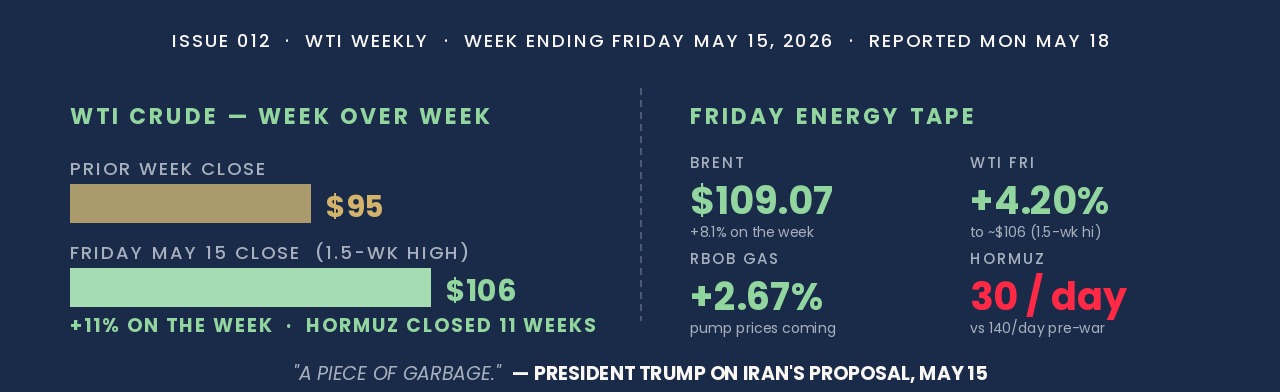
Friday rebuilt the supply-shock premium that the early-week Trump-Xi summit had briefly compressed. WTI crude jumped 4.20 percent to close near $106 a barrel — a 1.5-week high — and finished the week up roughly 11 percent. Brent rose 3.17 percent to $109.07 and added 8.1 percent on the week. The catalyst: Trump told reporters he had read Iran’s latest peace proposal and called the first sentence “a piece of garbage,” declaring the existing ceasefire “on life support” and warning that Iran would “make a deal or be decimated.” The Strait of Hormuz remains effectively closed for the eleventh consecutive week. The International Energy Agency now estimates the war has removed roughly 10 million barrels per day of crude and refined-product flows through the Strait — the largest oil supply disruption in history.
The cross-asset confirmation was uniform: the 10-year Treasury yield ripped to 4.59 percent — its highest since February 2025 — on war-inflation pricing, gold dropped 2 percent to $4,556 as the dollar posted its best weekly gain in two months, and equities sold off 1.2 percent across the board. Dan Niles, founder of Niles Investment Management, told CNBC 10 of the last 12 US recessions were preceded by an oil-price spike. The EIA’s May Short-Term Energy Outlook now projects Brent averaging $106/b in Q2 and global oil inventories drawing at 8.5 mb/d. Inside, we unpack why the “piece of garbage” remark reset the cycle, how to read Berkshire’s material Q1 trim to its Chevron position (filed Friday) against the supermajor retreat thesis, and what the EIA’s assumption of a late-May to early-June Hormuz reopening means for the trade if the diplomatic track keeps slipping.
|
WTI +11% on the week as Trump calls Iran’s proposal ‘a piece of garbage.’
Eleven weeks into the conflict, the diplomatic track that briefly looked credible has collapsed back to public insults. The Trump-Xi summit ended Thursday without any concrete plan to reopen the Strait of Hormuz. The Chinese state-media readout omitted the Hormuz commitment entirely. Trump then publicly rejected Iran’s next proposal. Crude futures spent Friday repricing the disruption back into the curve — and gasoline followed (+2.67%), natural gas printed a six-week high (+2.28%), and the 10-year Treasury yield ripped to 4.59 percent as energy-inflation pass-through went from forecast to fact.
WTI +11% on the Week · Brent +8% · Hormuz Closed Week 11 · Friday, May 15, 2026
Start with the price action. June WTI crude (CLM26) closed up $4.25 (+4.20 percent) at roughly $106 a barrel — a 1.5-week high — and finished the week up about 11 percent. Brent rose 3.17 percent to $109.07, up 8.1 percent on the week. June RBOB gasoline added 2.67 percent. June Henry Hub natural gas printed a six-week high at +2.28 percent. The catalyst was sequencing: the Trump-Xi summit ended Thursday without any concrete plan to reopen the Strait of Hormuz; Xinhua’s Chinese-language readout did not mention Hormuz or US oil purchases; then Friday morning Trump told reporters he had read Iran’s latest peace proposal and called the first sentence “a piece of garbage” while declaring the existing ceasefire “on life support.” Energy Secretary Chris Wright spent Friday at Port Arthur, Texas talking up US export capacity. The market read the package as a confirmation that the diplomatic track has slipped to a multi-month problem, not a multi-week one.
The supply context keeps tightening. The International Energy Agency now estimates the war has removed approximately 10 million barrels per day of combined crude and refined-product flows through the Strait of Hormuz — the largest single supply disruption in oil-market history, equivalent to roughly 10 percent of global consumption. The EIA’s May Short-Term Energy Outlook now assumes Hormuz remains effectively closed through late May with flows beginning to resume only in late May or early June, and projects global oil inventories will draw at an average of 8.5 million b/d in Q2 with Brent averaging $106 per barrel through May and June before easing to roughly $89 by Q4 once flows normalize. Tanker traffic through the Strait ran at roughly 30 vessels in the most-recent 24-hour window — against a pre-war norm of approximately 140 per day. Kpler’s comparable count earlier in the week showed only 5-7 ships per day. Iran said the May 15 figure rose to about 30; the structural delta from pre-war is still ~80 percent.
The cross-asset confirmation was uniform. The US 10-year Treasury yield rose roughly 10 basis points to 4.59 percent — its highest level since February 2025 — on energy-driven inflation pricing. The dollar index set up for its best weekly gain in two months. Gold dropped 2 percent to $4,556.46 per ounce, its lowest since May 5. The S&P 500 fell 1.24 percent, surrendering the 7,500 level it had just crossed Thursday; the Dow lost 50,000 again on the same session. The clearest institutional read came from Berkshire Hathaway’s Q1 13F filed Friday — CEO Greg Abel’s first — which disclosed a material trim to the Chevron position alongside complete exits from Amazon, Visa, Mastercard, and UnitedHealth. Dan Niles, founder of Niles Investment Management, captured the macro setup on CNBC Friday: “10 of the last 12 recessions were preceded by a spike in oil. This is starting to get uncomfortable.” Energy-equity earnings are sitting on rising crude price decks while the underlying demand environment is now repricing toward contraction. Both can be priced in. Both are being priced in.
|
+11%
WTI weekly gain (Brent +8.1%)
|
$109.07
Brent close Friday (WTI ~$105)
|
|
~10 mb/d
Hormuz disruption (IEA estimate)
|
4.59%
10Y yield (war-inflation pricing)
|
|
Three angles, depending on where you sit in the energy chain.
|
If you fill up a gas tank
RBOB gasoline futures gained 2.67 percent Friday on the same session WTI was up 11 percent for the week — that flows directly to the pump within 7-14 days. Plan summer driving budgets at 12-18 percent above your March baseline, with national retail averages likely retesting the highest summer levels in three years through Memorial Day. The EIA’s base case now puts Brent at $106 through May and June; the war-extension scenario (Trump rejected Iran’s proposal Friday) pushes that band higher. Natural gas also printed a six-week high on the same session, so home heating and electricity bills face the same pressure when you read your June statement. If you have flexibility on a major vehicle decision, the EV math is the cleanest it has been in three years; if not, defer optional driving and pre-buy fuel at warehouse-club discounts where you can.
|
|
|
If you run an oil & gas or refining operation
The EIA’s May Short-Term Energy Outlook now models global oil inventories drawing at an average of 8.5 million b/d through Q2 with Brent averaging $106 per barrel through May and June before fading to roughly $89 by Q4 if Hormuz traffic resumes. Trump’s “piece of garbage” rejection of Iran’s proposal Friday extends the closure scenario, not shortens it. If you operate US E&P or LNG export capacity, this is the window to forward-sell incremental volumes at $100+ price decks before the curve normalizes — the back end is already pricing the recovery. Refining margins remain wide; lock crack-spread hedges out 6-9 months while volatility is paying you to hedge. If you operate Asia-Pacific downstream exposure, follow Chevron’s lead and quietly market non-core regional assets to buyers like ENEOS who are consolidating capacity at distressed multiples.
|
|
|
If you hold energy equities or watch the policy desk
The Berkshire Q1 13F filing on Friday showed a material trim to Chevron alongside complete exits from financial-payment and large-cap retail names. Abel’s first 13F as CEO is not a vote against energy — the portfolio is more concentrated, not de-risked — but it is a vote against captive Middle East exposure at current valuations. Overweight US E&P with concentrated Permian, Eagle Ford, and DJ basin acreage (EOG, Pioneer, Diamondback, Devon); equal-weight integrated US names with material LNG capacity (Cheniere, the LNG infrastructure cohort). The pair: short the Asia-exposed refining-margin cohort facing the war-driven feedstock cost reset (ENEOS aside, where the consolidation is the trade). Trump’s “life support” framing on the ceasefire is the binary signal: track tanker count weekly — under 10 ships per day means the trade extends; above 100 ships per day means the trade reverses sharply.
|
|
|
Four other moves from Friday that all pointed the same direction.
|
|
Trump rejects Iran proposal: ‘a piece of garbage’ · ceasefire ‘on life support.’
Speaking to reporters Friday, President Trump said he had reviewed Iran’s latest peace proposal and called the first sentence “a piece of garbage” while warning Iran “will make a deal or be decimated.” He described the existing ceasefire as “on life support.” The administration also signaled it may restart the operation to escort commercial shipping through the Strait of Hormuz with naval and air support as soon as this week. Oil markets read the package as definitive: the diplomatic track is back to first principles, not on the cusp of breakthrough. WTI added more than $4 a barrel on the back of the remarks alone.
|
|
|
Berkshire materially trims Chevron in Abel’s first 13F.
Berkshire Hathaway’s Q1 13F — filed Friday, the first under new CEO Greg Abel — disclosed a material reduction in the Chevron position alongside complete exits from Amazon, Visa, Mastercard, UnitedHealth, and several other large holdings. Abel concentrated the equity book from 40 holdings to 26 and raised cash to a record $397.4 billion. The Chevron trim is not a vote against energy — the firm remains a top-five holding — but it is a vote against captive Middle East exposure at current valuations. For energy-equity allocators, the cleanest read is: rotate the integrated-oil sleeve toward US-only E&P names with concentrated Permian, Eagle Ford, and DJ basin acreage.
|
|
|
Niles on CNBC: 10 of last 12 recessions preceded by an oil spike.
Dan Niles, founder of Niles Investment Management, told CNBC’s “Power Lunch” Friday that “this is starting to get uncomfortable” and that 10 of the last 12 US recessions were preceded by an oil-price spike. He added that the Federal Reserve’s ability to cut rates in the future could be hampered by oil’s impact on inflation — traders now see the Fed raising rates for its next move. The 10-year Treasury yield closed at 4.59 percent, its highest since February 2025; the dollar posted its best weekly gain in two months. The cross-asset confirmation is doing the work the equity tape was masking earlier in the week.
|
|
|
New Mexico now collecting $59 million for every $1 added to a barrel.
The Associated Press reported Friday that New Mexico is generating roughly $59 million in incremental state revenue for every $1 added to the price of a barrel of oil — making it the cleanest single-state read on the fiscal upside flowing through the US producing states from the war-driven price spike. The figure is the practical confirmation of why state-level political support for sustained US production growth is hardening regardless of the federal energy-policy framework. For energy-focused real-asset investors, the southern New Mexico Permian footprint is the highest-quality location-specific exposure in the public markets right now.
|
|
|
◆ Bluff Check
Where today’s loudest narrative meets the data.
Markets are noisy. Executives talk their book. Press releases bury the lead. Each day we surface one prominent claim from the tape — a CEO quote, a research note, an official statement — and check it against the data. If the numbers back it up, we call it REAL. If the framing is doing more work than the evidence, we call it BLUFF. No drama, no theatrics — just the read.
| |
“China, as the world’s largest importer, will buy more oil from the US in the future. There’s a natural energy trade there.”
— Chris Wright, US Energy Secretary, CNBC interview at Port Arthur TX, Friday May 15
Our Read
The framing is that the Trump-Xi summit cleared the path for a structural US-to-China crude trade that backstops the Hormuz disruption. The data argues otherwise. Xinhua’s Chinese-language readout of the same summit made no mention of US oil purchases. Trump told Fox News that “China has an insatiable appetite” for US oil — but no contracted volume, no signed offtake, no shipping schedule, and no payment-channel framework was disclosed. Meanwhile, the Trump administration on Friday allowed the waiver permitting Russian crude sales (a structural China feedstock) to lapse despite India’s appeal for an extension — tightening, not loosening, the dollar-cleared crude trade China actually relies on. Aspirational trade flows do not heat homes. The US can grow exports at the margin, but China’s 13+ mb/d import need is not getting redirected meaningfully on a Beijing-summit news cycle. The verdict reads from price, not policy.
|
|
|
◆ The KNOWIDEA Lens
Here’s how we’re reading the ceasefire collapse.
Our Predictive Intelligence Engine ran Friday’s signals — the WTI +11 percent weekly close, Trump’s “piece of garbage” rejection of Iran’s proposal, the EIA STEO assuming Hormuz closure through late May, Berkshire’s material Chevron trim, and the 10-year yield breakout to 4.59 percent — through 5 active data streams. Here’s what it surfaced.
| |
|
◆ Predictive Insight
Pure-play US E&P names with concentrated Permian, Eagle Ford, and DJ Basin acreage and minimal Middle East exposure face 71% probability of 12–20% outperformance vs the broad IOC cohort over the next 60 days — driven by Trump’s Friday rejection of Iran’s peace proposal extending the Hormuz closure scenario into June minimum, the EIA STEO assuming an 8.5 mb/d Q2 global inventory draw with Brent averaging $106 per barrel, the Berkshire Q1 13F trimming Chevron specifically (not energy broadly), and the New Mexico fiscal-windfall data (~$59M per $1 incremental barrel) confirming state-level political support for sustained US production growth regardless of federal policy framework.
|
Confidence
71%
|
Downside Risk
Medium
|
Horizon
60 days
|
|
What we'd do today →
|
1
|
Overweight pure-play US E&P with concentrated Permian and Eagle Ford acreage. EOG Resources, Diamondback Energy, Pioneer Natural Resources, Devon Energy, and Coterra are the cleanest expressions of the “US-only crude exposure” trade. Equal-weight the basket, hold for 60 days. The thesis: every additional week of Hormuz closure pulls more capital toward US-only producers and away from IOC names with Middle East trapped exposure. Berkshire’s Friday Chevron trim is the institutional template. Trim only on a confirmed Iran deal that produces a verifiable Hormuz reopening within 14 days.
|
|
2
|
Hedge crack spreads at the wide while volatility pays you to do it. RBOB gasoline added 2.67 percent Friday, US gulf-coast distillate cracks are at multi-year highs, and refining-margin volatility is elevated. Operators with refining capacity should lock 6-9 month crack-spread hedges at current levels — the EIA STEO base case has Brent fading to $89 by Q4 as Hormuz traffic resumes, which would compress crack economics back to historical norms. Don’t hedge the full book; preserve enough exposure to participate if the war extension scenario plays through. Target roughly 50-60 percent hedge ratio on near-term volumes.
|
|
3
|
Watch the Hormuz tanker count and any restart of the US naval-escort operation this week. Trump signaled Friday the administration may restart the operation to escort commercial ships through the Strait with naval and air support “as soon as this week.” That is the binary signal worth tracking: if escort operations restart and tanker counts move into the 50-plus per day range within 14 days, war-premium compression accelerates and Brent fades toward the EIA $89 Q4 base case. If counts stay below 20 per day, the trade extends and crude retests $115-plus. Don’t size large directional positioning until the transit data resolves; do put any spare delta into Permian-pure-play E&P names where the asymmetric upside is highest and the Hormuz-resolution downside is most muted.
|
|
|
◆ Want this on your operation?
30 minutes. The complete read on your positions.
We apply Friday’s signals to your specific operation — feedstock contracts, refining margins, hedge positioning — and walk through what P.I.E. recommends for you. No pitch. If we’re not a fit, we’ll tell you in the first 5 minutes.
|
|
Powered by the P.I.E. · Predictive Intelligence Engine
FUSE
›
SCAN
›
POSITION
›
CONVERT
›
PREDICT
›
DISTILL
›
DECIDE
|
|
KNOWIDEA
Predictive Intelligence Engine
© 2026 KNOWIDEA Technologies Ltd. · SOC 2 Verified
|
|