|
Issue No. 013 · Tue, May 19, 2026
|
● Daily Brief
|
|
|
Decision Layer
|
Oil & Energy
· 5 min read
|
|
| YS |
From Yatharth Sejpal · CEO, KNOWIDEA |
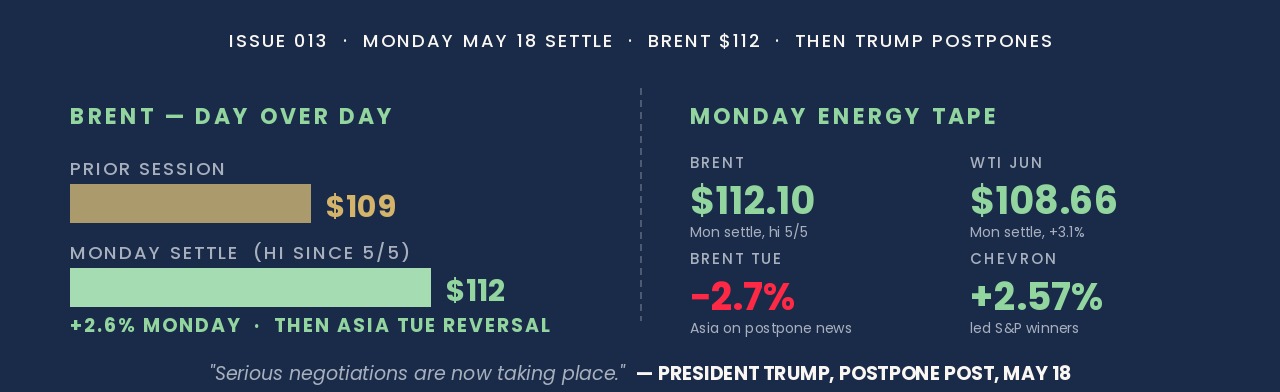
Monday delivered the curve’s sharpest two-legged session of the war. The first leg priced the escalation: Trump posted on Truth Social Monday morning that “the clock is ticking” and that Iran “better get moving FAST, or there won’t be anything left of them.” A weekend drone strike sparked a fire near the UAE’s only nuclear plant. Brent July futures rose $2.84 (+2.6 percent) to settle at $112.10 a barrel — the highest close since May 5. WTI June futures gained $3.24 (+3.1 percent) to settle at $108.66 — the highest since April 30. June RBOB gasoline pushed to a near-four-year high. The second leg arrived after the bell. Trump posted again Monday evening, this time announcing he was postponing a planned Tuesday strike on Iran after personal requests from the leaders of Qatar, Saudi Arabia, and the United Arab Emirates, who told him “serious negotiations are now taking place.” Brent dipped back below $110 in extended trade; by early Tuesday Asian hours both Brent and WTI were down roughly 2 to 2.7 percent.
The mediation track is now the operative variable. Pakistan has delivered Iran’s revised proposal to Washington; both sides have exchanged comments. Iran’s Tasnim news agency reported Tehran sees the US accepting a temporary waiver on Iran oil sanctions during the talks period. The revised Iranian terms reportedly include a long-term nuclear freeze (not full dismantling), transfer of enriched uranium to Russia rather than the US, dropped demands for direct US financial compensation in exchange for international guarantees, and a gradual peace arrangement. The Strait of Hormuz remains effectively closed; the US-imposed Iranian-port blockade remains in force. The International Energy Agency warned Monday that global oil inventories are declining rapidly. Inside, we unpack why the curve’s back end (Brent calendar spreads, July-Dec) is now the cleanest expression of the bilateral outcome, what the rumored US sanctions-waiver carrot does to global supply if it goes live, and how to read the Eurogroup’s G7 statement in Paris that “opening the Strait of Hormuz and bringing the conflict to a lasting end are of the utmost importance.”
|
Brent +2.6% to $112. Then Trump postpones the Iran strike. Now what.
Monday was the cleanest two-leg session of the war. Crude raced higher into the close on a weekend UAE-nuclear drone strike and Trump’s “TIME IS OF THE ESSENCE” framing. Then, four hours after the close, the same president posted that he was holding off on a Tuesday strike at the personal request of Qatar, Saudi Arabia, and the UAE because “serious negotiations are now taking place.” The reversal was immediate: by Tuesday-morning Asian trade Brent was back below $110, WTI July (the new front month) was off 2 percent to $102. The trade is no longer about whether the supply shock continues — it is about how Tehran responds to the carrot of an oil-sanctions waiver Iran says Washington has accepted in the latest draft.
Monday Settle · Brent +2.6% to $112.10 · Then Trump Postpones Tuesday Strike · Mon, May 18, 2026
Start with the settlement-day move. Brent crude July futures rose $2.84 (+2.6 percent) to settle at $112.10 a barrel — the highest closing level since May 5. WTI June futures gained $3.24 (+3.1 percent) to settle at $108.66 — the highest since April 30. June RBOB gasoline pushed to a near-four-year high. The catalysts stacked: a weekend drone strike sparked a fire near the UAE’s only nuclear plant in what authorities called an “unprovoked terrorist attack” (no injuries, no radiation release); Trump posted Monday morning that “for Iran, the clock is ticking, and they better get moving FAST, or there won’t be anything left of them. TIME IS OF THE ESSENCE!”; Axios reported Trump had been weighing renewed military action after Iran’s latest proposal “fell short of expectations.” The Strait of Hormuz remains effectively closed; tanker traffic continues to run at roughly 20-30 vessels per 24 hours against a pre-war norm of approximately 140 per day.
The reversal arrived after the close. Trump posted on Truth Social that he was postponing the planned Tuesday strike on Iran after the leaders of Qatar, Saudi Arabia, and the United Arab Emirates personally requested he “hold off” because “serious negotiations are now taking place.” The post instructed the Pentagon to remain prepared for “a full, large scale assault of Iran, on a moment’s notice, in the event that an acceptable Deal is not reached.” Brent dipped back below $110 in extended trade; by early Tuesday Asian hours Brent July had fallen $3.01 (-2.7 percent) to $109.09 a barrel, WTI June had fallen $1.38 (-1.3 percent) to $107.28, and the more-active WTI July contract had fallen $2.06 (-2 percent) to $102.32. June WTI expires at Tuesday’s close. Iran’s revised proposal — relayed via Pakistani mediators — reportedly includes a long-term nuclear freeze (not full dismantling), transfer of enriched uranium to Russia rather than the US, dropped demands for direct US financial compensation in exchange for international guarantees, and a gradual peace arrangement. Iran’s Tasnim news agency separately reported the latest US text accepts a temporary waiver on Iran oil sanctions during the talks period — an explicit supply carrot that has not been publicly confirmed by US officials.
The macro context is hardening even as crude reverses. The International Energy Agency warned Monday that global oil inventories are declining rapidly. At the G7 finance-ministers meeting in Paris, Eurogroup President Kyriakos Pierrakakis said opening the Strait of Hormuz and bringing the conflict to a lasting end are “of the utmost importance” in mitigating the impact on the global economy. The US 10-year Treasury yield touched 4.63 percent intraday Monday on energy-inflation pricing. The 30-year hovered near 5.13 percent, a level last seen in 2007. Chevron led S&P 500 winners at +2.57 percent — the cleanest equity-tape confirmation that the war-premium repricing has institutional support. ING analysts and Reuters mediation contacts both note the Pakistan-mediated parties “don’t have much time to narrow their differences.” The trade now hinges on a single binary outcome inside roughly 7-14 days: either Iran accepts a framework that includes a Hormuz-reopening commitment and a sanctions waiver lights up new supply, or the Pakistan track collapses and Trump executes on the “moment’s notice” clause. Position for both.
|
$112.10
Brent Monday settle (+2.6%, hi since 5/5)
|
$108.66
WTI June settle (+3.1%, hi since 4/30)
|
|
−2.7%
Brent in Asia Tuesday (Trump postpone)
|
+2.57%
Chevron (CVX) led S&P winners
|
|
Three angles, depending on where you sit in the energy chain.
|
If you fill up a gas tank
June RBOB gasoline hit a near-four-year high on Monday’s settle before easing in extended trade. The pump-price impact lags the futures move by roughly 7-14 days, so the May 18 spike still has to flow through. Plan summer driving budgets at 12-18 percent above your March baseline as the base case. If Trump’s postponement holds and Iran accepts the framework that includes the rumored sanctions-waiver carrot, retail prices could roll over by 6-8 percent inside three weeks — do not pre-buy in bulk if you have storage flexibility. If the diplomatic track collapses (Trump retained the “moment’s notice” clause), pump averages retest summer 2022 highs. The cleanest hedge for a household: lock 3-4 months of EV charging credits now if your utility offers fixed-rate pre-pay; the variable rate is what tracks the war.
|
|
|
If you run an oil & gas or refining operation
The curve told you the binary is alive: Brent July settled at $112.10 on Monday, dropped 2.7 percent in Asia Tuesday on the Trump postponement. The implied vol that paid for hedges last week just got cheaper at the back end and stayed expensive at the front. If you operate US E&P, sell incremental forward volumes into the curve through Q3 at $100-plus price decks before any sanctions-waiver framework reprices the back end. If you operate refining capacity, the rumored Iran-sanctions waiver is the real risk to your current margins — widen your hedge ratio on 6-9 month crack spreads to 60-70 percent. The IEA’s Monday warning that global inventories are declining rapidly is the cleanest demand-side signal that even a partial Hormuz reopening leaves the supply-and-demand math tight through Q3 unless Iranian exports return at scale.
|
|
|
If you hold energy equities or watch the policy desk
Chevron leading S&P winners at +2.57 percent on Monday is the cleanest institutional read on the trade post-postponement: the equity market is pricing a partial-resolution outcome that still leaves crude structurally above $90 through Q3. Hold Chevron, Exxon, ConocoPhillips, EOG, Diamondback into the next 14-day diplomatic window. Add Cheniere and the US LNG complex as the pure-supply-add play if the rumored Iran-sanctions waiver lights up Chinese demand for non-sanctioned crude. Pair against the short-vol options trade on July Brent: implied vol came in 30+ percent off recent highs but the binary timeline is shortening, not lengthening. Track three signals: (1) Hormuz tanker count daily, (2) any US official confirmation of the sanctions-waiver framework, (3) Pentagon posture on the “moment’s notice” clause.
|
|
|
Four other Monday signals all pointing at the same binary.
|
|
Drone strike sparks fire near UAE’s only nuclear plant.
A weekend drone strike sparked a fire near the Barakah nuclear power plant on the UAE’s Persian Gulf coast — the country’s only nuclear facility — in what UAE authorities called an “unprovoked terrorist attack,” per the Associated Press. There were no reported injuries and no radiological release. The attack was the catalyst that priced into Monday’s opening tape: Brent gapped higher at the Asian-session open, the rally extended through US trading hours on Trump’s morning “TIME IS OF THE ESSENCE!” post, and settled +2.6 percent on the day at $112.10. Other Persian Gulf energy infrastructure also came under attack over the weekend. The strike forced the diplomatic clock forward by 48-72 hours; the Trump postponement that followed reset it.
|
|
|
Iran’s revised terms via Pakistan: nuclear freeze, uranium to Russia, sanctions-waiver carrot.
Pakistani mediators delivered Iran’s revised proposal to Washington Monday. Per reporting from CBS News, Reuters, and Iran’s semi-official Tasnim agency, Tehran’s new terms include a long-term nuclear freeze (not full dismantling), transfer of enriched uranium to Russia rather than the US, dropped demands for direct US financial compensation in exchange for international guarantees, and a gradual peace arrangement with the US and Israel. Tasnim separately reported the latest US text accepts a temporary waiver on Iran oil sanctions during the talks period — not publicly confirmed by US officials. A Pakistani source warned Reuters the parties “don’t have much time to narrow their differences.” If the waiver framework lights up, the back end of the Brent curve fades fast.
|
|
|
IEA: global inventories declining rapidly. Eurogroup at G7: Hormuz reopening ‘of utmost importance.’
The International Energy Agency warned Monday that global oil inventories are declining rapidly on sustained Hormuz disruption and resilient Q2 demand. At the G7 finance-ministers meeting in Paris the same day, Eurogroup President Kyriakos Pierrakakis — the Greek finance minister and current Eurogroup chair — said in a formal statement that “opening the Strait of Hormuz and bringing the conflict to a lasting end are of the utmost importance” for the global economy. The framing matters: the IEA flag plus the Eurogroup G7 statement is the cleanest institutional alarm of the war so far and the strongest pressure on Washington to accept a framework that re-opens supply.
|
|
|
WTI June expires Tuesday. July is the new front month — at $102.
The mechanical roll matters here. June WTI (CLM26) settled Monday at $108.66 and expires at Tuesday’s close. The more-active July contract (CLN26) was already trading roughly $6 lower than June at the Monday settle — and fell $2.06 (-2 percent) to $102.32 in early Tuesday Asian trade on the Trump postponement. That is the curve speaking: the market sees the maximum-disruption window as already in the rear-view, with structural backwardation pricing the assumption that any Iran framework (or even a credible postponement) re-opens Hormuz on a 30-60 day timeline. Hedgers operating on the front month: do not roll passively. The shape of the curve from here is the trade.
|
|
|
◆ Bluff Check
Where today’s loudest narrative meets the data.
Markets are noisy. Executives talk their book. Press releases bury the lead. Each day we surface one prominent claim from the tape — a CEO quote, a research note, an official statement — and check it against the data. If the numbers back it up, we call it REAL. If the framing is doing more work than the evidence, we call it BLUFF. No drama, no theatrics — just the read.
| |
“Serious negotiations are now taking place. … A deal acceptable to the U.S. will be reached.”
— President Trump, Truth Social, postponement-announcement post, Monday evening May 18
Our Read
Oil reversed 2.7 percent in extended trade because the market read the post as a peace breakthrough. The data does not back the framing. The same post instructed the Pentagon to remain prepared for “a full, large scale assault of Iran, on a moment’s notice, in the event that an acceptable Deal is not reached” — the operational posture is delay, not de-escalation. Earlier the same day, Axios reported Trump “had been weighing renewed military action after Tehran’s latest proposal … fell short of expectations.” The Pakistani mediator separately warned Reuters the parties “don’t have much time to narrow their differences.” Trump told the New York Post the same day Iran knows “what’s going to be happening soon.” The Strait of Hormuz remains effectively closed; the US blockade of Iranian ports remains in force; the existing April 8 ceasefire is on “life support.” A postponement requested by three Gulf monarchies with strong commercial incentive to avoid a US strike on their doorstep is not the same as a framework headed for ratification. Until tanker traffic through Hormuz returns toward pre-war volume, the operative read is delay, not deal.
|
|
|
◆ The KNOWIDEA Lens
Here’s how we’re reading the Iran-track binary.
Our Predictive Intelligence Engine ran Monday’s signals — Brent settling at $112.10 and reversing 2.7 percent in Asia Tuesday, Trump’s after-hours Iran-strike postponement with the “moment’s notice” clause retained, Iran’s revised proposal via Pakistan with the rumored US sanctions-waiver carrot, the IEA inventory warning, and the Eurogroup’s “utmost importance” framing at G7 Paris — through 5 active data streams. Here’s what it surfaced.
| |
|
◆ Predictive Insight
The Pakistan-mediated Iran track resolves to one of two outcomes inside 14 days: framework accepted with a rumored sanctions-waiver carrot, or framework rejected and the “moment’s notice” strike clause fires. 66% probability the binary fades crude 8–14% from Monday’s settle before mid-June — driven by (a) three Gulf monarchies actively pressuring Washington toward the diplomatic path, (b) Iran’s revised terms now including transferable enriched uranium and dropped financial compensation, (c) the IEA-flagged rapid inventory drawdown raising European pressure to re-open Hormuz, (d) the WTI July contract already at $102 versus June’s $108.66 settle — the curve telling you the disruption peak is in. Asymmetric tail: framework rejection produces a $115-120 Brent revisit, but the curve shape says the market is pricing 65-35 toward resolution, not stalemate.
|
Confidence
66%
|
Downside Risk
Medium-High
|
Horizon
14 days
|
|
What we'd do today →
|
1
|
Buy the resolution-fade trade in the back end of the Brent curve. Pair short July-September Brent calendar spreads against long December-March Brent calendars at the current curve shape: front-month is over-pricing the maximum-disruption scenario; the back end is already where the EIA STEO has Brent fading to $89 once Hormuz reopens. The Trump postponement plus Iran’s revised terms plus the Eurogroup G7 statement are three independent signals all pointing toward resolution inside two weeks. Size at 1.5-2 percent of NAV; cap downside via a long-dated July Brent $115 call to capture the reject-and-strike tail. Trim only if Hormuz tanker count drops below 10 ships/day in any single 24-hour window.
|
|
2
|
Hold US LNG and integrated majors that benefit either way. Chevron leading S&P winners at +2.57 percent Monday is the cleanest read: the institutional bid is on names that win on extended disruption AND on names that re-rate higher into a normalized post-war environment. Hold Chevron, ExxonMobil, ConocoPhillips, Cheniere, and Tellurian at full position weight through the 14-day window. The asymmetry is in your favor: war-extension scenario takes crude back to $115-plus and these names rally; resolution scenario lights up sanctioned Iranian crude back into the market but global structural demand still favors low-cost US LNG and Permian producers through Q3. Avoid pure-play E&P names without integrated downstream — they are the cohort that gets hurt most if the sanctions-waiver carrot reprices the curve in 48 hours.
|
|
3
|
Track three signals daily — they resolve the binary before headlines do. (1) Hormuz tanker count: if it climbs above 60 ships/24 hours in any session this week, the resolution scenario is reading through; below 20 means the trade extends. (2) US official confirmation of the rumored Iran-sanctions waiver: Iran’s Tasnim agency claimed Washington accepted the waiver; no US official has confirmed. Confirmation would be the cleanest framework signal. (3) Pentagon “moment’s notice” posture: a CENTCOM force-posture change toward de-escalation (carriers redeployed, B-2 detachment recalled) is the most credible signal Trump’s post-language matches operational reality. Until at least two of three turn green, treat the postponement as delay, not deal — and size your trades for both outcomes.
|
|
|
◆ Want this on your operation?
30 minutes. The complete read on your positions.
We apply Monday’s signals to your specific operation — feedstock contracts, refining margins, hedge positioning — and walk through what P.I.E. recommends for you. No pitch. If we’re not a fit, we’ll tell you in the first 5 minutes.
|
|
Powered by the P.I.E. · Predictive Intelligence Engine
FUSE
›
SCAN
›
POSITION
›
CONVERT
›
PREDICT
›
DISTILL
›
DECIDE
|
|
KNOWIDEA
Predictive Intelligence Engine
© 2026 KNOWIDEA Technologies Ltd. · SOC 2 Verified
|
|